
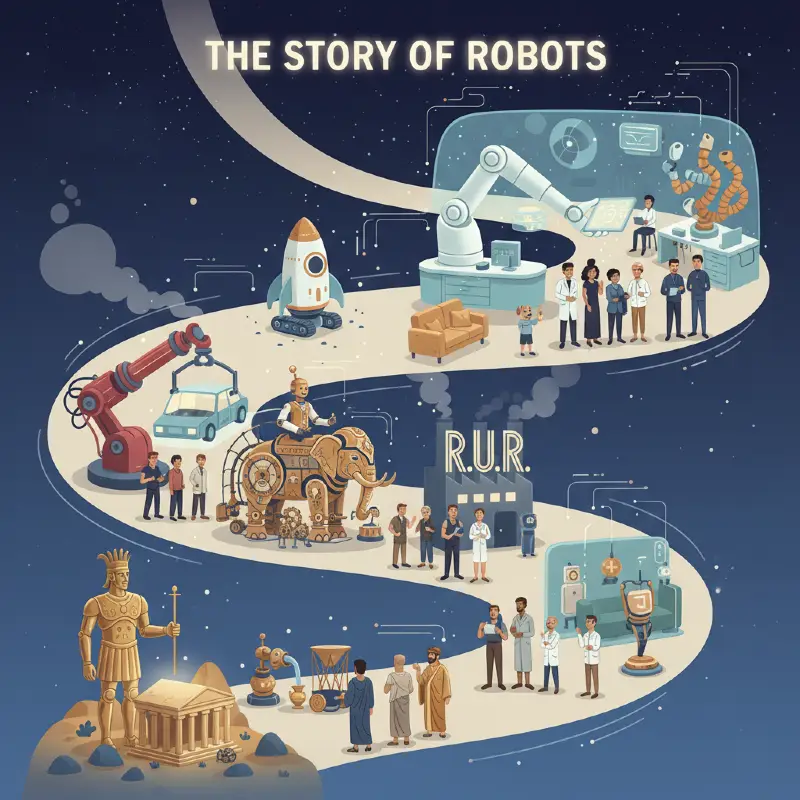
The history of robots is really the story of people wanting to build helpful partners that can do hard work for us. For thousands of years, humans have dreamed of making machines that act like living things. This dream started as magic stories in ancient times and turned into the high-tech machines we use today.
This article looks at how the idea of robots grew. We will start with ancient myths and the first “self-moving” machines. Then, we will see how the Industrial Revolution and a famous play gave robots their name. Finally, we’ll see how robots became smart enough to work right alongside humans.
I. From Magic Stories to Early Machines
Long before computer chips existed, people dreamed of mechanical helpers. This old dream is the start of all robotics. In Ancient Greece, stories told of a god named Hephaestus who built golden assistants and moving tables. One of his most famous stories was about Talos, a giant bronze man built to guard an island¹. These stories were the world’s first ideas for artificial life.
Eventually, thinkers started building real machines that moved on their own. These were called automata. In the first century, engineers like Hero of Alexandria made coin-operated water machines and doors that opened by themselves using steam and air. Later, during the Islamic Golden Age, a brilliant man named Al-Jazari built even better machines, like a giant elephant clock and robots that could play music².
By the 1700s, inventors in Europe made “androids” that looked like people or animals. One famous machine was a duck that seemed to eat, and others were mechanical dolls that could write or play piano³. While these were amazing to look at, they weren’t “smart.” They just followed one set of instructions hidden in their gears. You couldn’t easily change what they did, but they proved that machines could copy human actions.
II. Factories and the First “Robot”
When the Industrial Revolution happened, factories needed machines that could work fast without getting tired. This changed the focus from “toy” machines to “work” machines. Engineers created systems that could check their own work and fix mistakes—this is called feedback control, and it is the “brain” of every modern robot⁴.
In 1920, a writer named Karel Čapek wrote a play called R.U.R. He used the word “robot” for the first time. It comes from an old word that means “forced labor” or “hard work”⁵. This changed how people thought. An “automaton” was a toy for fun, but a “robot” was a machine built to do a job.
During World War II, technology moved even faster. Scientists needed better computers to aim weapons and solve math problems. These new computers and factory machines paved the way for the first truly programmable robots.
III. The First Industrial Robots
In the 1950s, George Devol came up with a way for a machine to “remember” a series of movements. He teamed up with Joseph Engelberger, who is now called the “Father of Robotics”⁶ ⁷. Together, they built the Unimate, the world’s first industrial robot.
In 1961, the Unimate started working at a car factory. Its job was to pick up hot pieces of metal that were too dangerous for humans to touch⁸. It was a huge success! Soon, countries like Japan began building their own robots to make electronics and cars even faster⁹.
Around this time, a famous writer named Isaac Asimov came up with the Three Laws of Robotics. These were rules to make sure robots would never hurt people¹⁰. Even though they were from stories, they made scientists think about how to keep humans safe around machines.
IV. Adding “Eyes” and “Brains”
In the 1980s, computers became smaller and cheaper. This allowed robots to do more than just repeat the same movement. Robots could finally “think” a little bit because they had microprocessors¹¹.
Engineers added sensors, which are like a robot’s eyes and hands. With cameras, robots could “see” objects and move them. With touch sensors, they could tell if they were holding something fragile, like a lightbulb¹². Some robots were built to move very fast, like the Delta robot, which picks up food or medicine on a conveyor belt¹³.
Robots also started leaving the factory. NASA used them to explore other planets, and scientists built self-driving cars to navigate through the desert¹⁴. In 1999, Sony made a robot dog called AIBO, and in 2002, the Roomba vacuum became the first robot many people had in their homes¹⁵. Robots were becoming a part of everyday life.
V. Working Together Today
Today, we are in the age of “cobots” (collaborative robots). These are robots designed to work safely right next to people without being stuck behind a fence¹⁶. They use Artificial Intelligence (AI) to learn tasks by watching humans or by practicing on their own, rather than just following a rigid code¹⁷.
Robots are also becoming much more athletic. Companies like Boston Dynamics have built robots that can run, jump, and balance on two or four legs¹⁸. In hospitals, robots help doctors perform surgery with super-high precision¹⁹. We even have social robots that can talk to students or help take care of older people²⁰.
The future of robotics is still being invented. Scientists are now working on “soft robotics” using flexible materials that feel more like skin or muscle²¹. From the old legends of bronze guards to the smart partners of today, the goal remains the same: building machines that help humans reach further and do more.
Sources
- ¹ Mark, Joshua J. “Talos.” World History Encyclopedia. World History Encyclopedia, 2021. https://www.worldhistory.org/Talos/
- ² Hill, Donald R. “Mechanical Engineering in the Medieval Near East.” Scientific American, vol. 256, no. 5, 1991, pp. 100–106. https://www.semanticscholar.org/paper/MECHANICAL-ENGINEERING-IN-THE-MEDIEVAL-NEAR-EAST-Hill/5c82e2998fa0e708ab700bca3943f787eb8ef217
- ³ The Metropolitan Museum of Art. “The Automaton-Maker.” Heilbrunn Timeline of Art History. The Metropolitan Museum of Art, 2017. https://www.metmuseum.org/toah/hd/auto/hd_auto.htm
- ⁴ Mindell, David A. “Feedback Control, Information, and the History of Systems.” IEEE Control Systems Magazine, vol. 22, no. 5, 2002, pp. 110-114. https://ieeexplore.ieee.org/document/1036813
- ⁵ Science Museum Group. “The Czech Play That Gave Us the Word ‘Robot’.” Science History Blog. Science Museum Group, 2023. https://blog.sciencemuseumgroup.org.uk/the-czech-play-that-gave-us-the-word-robot/
- ⁶ U.S. Patent Office. “Programmed Article Transfer.” Patent US2988237A, filed by George C. Devol in 1954. https://patents.google.com/patent/US2988237A/en
- ⁷ Robotics Industries Association (RIA). “Joseph Engelberger: The Father of Robotics.” RIA Hall of Fame. RIA. https://www.automate.org/a3-content/joseph-engelberger-the-father-of-robotics
- ⁸ Smithsonian Magazine. “The First Industrial Robot: Unimate.” Smithsonian Institution. https://www.smithsonianmag.com/innovation/first-industrial-robot-unimate-180979603/
- ⁹ International Federation of Robotics (IFR). “A Brief History of Industrial Robotics.” IFR Publications. IFR. https://ifr.org/industrial-robots/history/
- ¹⁰ Asimov, Isaac. “Runaround.” Astounding Science Fiction, March 1942. https://www.britannica.com/topic/Runaround
- ¹¹ Brooks, Rodney A. “New Approaches to Robotics.” Science, vol. 253, no. 5025, 1991, pp. 1227-1232. https://www.science.org/doi/10.1126/science.253.5025.1227
- ¹² Dario, Paolo, and G. Sandini. “Robotics, Sensory.” Encyclopedia of Computer Science and Technology, vol. 27, 1993, pp. 317-347. https://www.worldcat.org/title/encyclopedia-of-computer-science-and-technology/oclc/449786
- ¹³ Siciliano, Bruno, and Oussama Khatib, editors. Springer Handbook of Robotics. Springer, 2008. https://books.google.com/books/about/Springer_Handbook_of_Robotics.html?id=Xpgi5gSuBxsC
- ¹⁴ Shaffer, Joshua. “The DARPA Grand Challenge and the Future of Autonomous Driving.” The New York Times, 2024. https://www.nytimes.com/2024/01/01/technology/darpa-grand-challenge-autonomous-driving.html
- ¹⁵ The Wall Street Journal. “iRobot’s Roomba, Twenty Years Later.” WSJ Tech Review, 2022. https://www.wsj.com/articles/irobot-roomba-twenty-years-later-11664058134
- ¹⁶ Cherifi, Bachir, et al. “A Review of Human-Robot Interaction and Collaborative Robotics: Safety and Control.” Robotics and Computer-Integrated Manufacturing, vol. 72, 2021, p. 102175. https://doi.org/10.1016/j.rcim.2021.102175
- ¹⁷ Kormushev, Petar, et al. “A Survey of Policy Search Methods for Robotics.” The International Journal of Robotics Research, vol. 35, no. 13, 2016, pp. 1655-1681. https://journals.sagepub.com/doi/10.1177/0278364916670879
- ¹⁸ Boston Dynamics. “Atlas.” Boston Dynamics Official Site. https://www.bostondynamics.com/atlas/
- ¹⁹ Simbini, Thubelihle, and Khumbulani Mpofu. “A Review of Surgical Robotic Systems and their Limitations.” International Journal of Advanced Robotics, vol. 1, no. 1, 2021, pp. 1-13. https://doi.org/10.3390/ijar1010001
- ²⁰ Tanioka, Takehiro, et al. “The Future of Social Robots in Elder Care: A Systematic Review.” Journal of Nursing Scholarship, vol. 54, no. 1, 2022, pp. 11-20. https://sigmapubs.onlinelibrary.wiley.com/doi/abs/10.1111/jnu.12720
- ²¹ Rus, Daniela, and Michael T. Tolley. “Design, Fabrication and Control of Soft Robots.” Nature, vol. 521, no. 7553, 2015, pp. 467-475. https://www.nature.com/articles/nature14543