
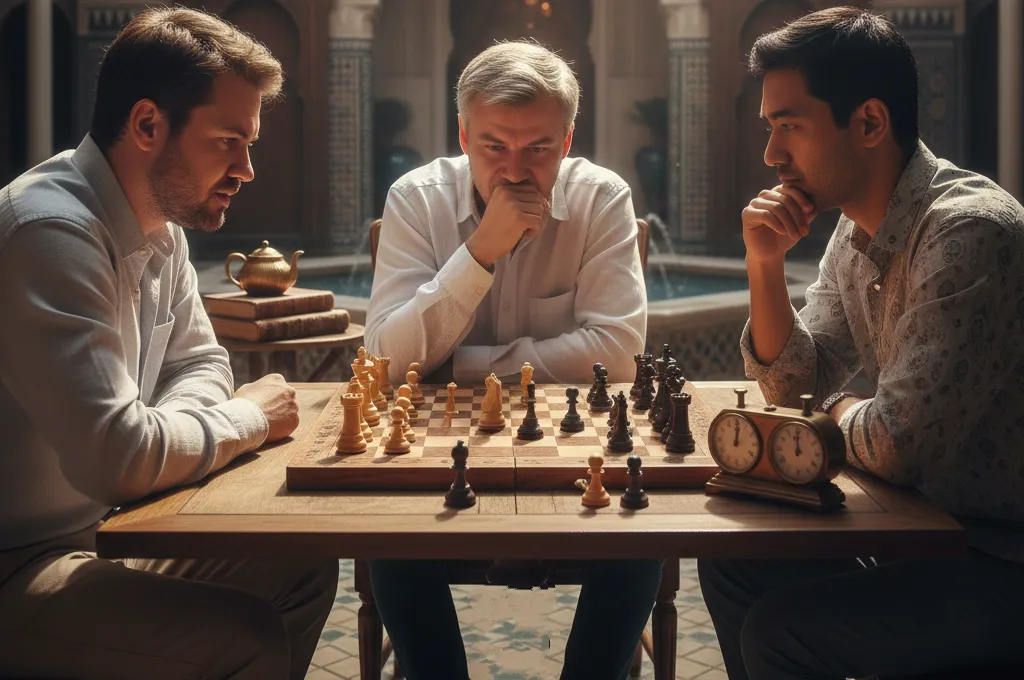
Chess is evolving. For decades, the professional chess world has struggled with a growing problem: “The Draw Death.” With engines like Stockfish becoming millions of times stronger than humans, opening theory has been analyzed to a drawish standstill. Grandmasters often memorize the first 20 to 25 moves of a game, resulting in contests that test memory more than creativity.
Enter Casablanca Chess.
Emerging prominently with the super-tournament in Casablanca, Morocco (featuring legends like Magnus Carlsen, Viswanathan Anand, and Hikaru Nakamura), this variant has rapidly become the most exciting alternative to standard chess. It promises to fix the boredom of opening theory without the total chaos of Fischer Random (Chess960).
If you want to master this new format, you are in the right place. This 1,500-word guide covers everything from Casablanca Chess rules and strategy to specific training techniques used by Grandmasters.
What Is Casablanca Chess?
Casablanca Chess is a chess variant designed to test a player’s middlegame understanding, calculation, and psychological adaptability.
In a standard game of chess, you start from the traditional setup. In Chess960 (Fischer Random), the back-rank pieces are shuffled randomly. Casablanca Chess sits comfortably in the middle.
In this variant, the game begins from a specific position taken from a historical chess game. These positions are carefully curated to be:
- Evaluated as Equal: The computer evaluation is roughly 0.00 (balanced).
- Structurally Rich: There are imbalances (e.g., Bishop vs. Knight, space advantages, or opposite-side castling) that allow for a fight.
- Unfinished: The game starts in the early middlegame, usually skipping the first 6 to 15 moves of opening theory.
By starting here, players cannot rely on their “prep.” They must rely on pure chess skill.
Casablanca Chess Rules: How It Works
While the gameplay itself follows standard FIDE laws of chess, the pre-game procedure is unique. Understanding the nuances of Casablanca Chess rules is the first step to mastering the game.
1. The Starting Position Protocol
Unlike standard chess, the board is not set up with pieces on the 1st and 8th ranks. Instead, an arbiter (or computer) sets up a specific position.
- Source Material: The position is derived from a real game played in the past—often a classic from the 19th or 20th century, or even an obscure Grandmaster game.
- The “Cut-Off” Point: The game typically resumes between Move 6 and Move 15. This is the “transition point” where opening theory usually ends and the middlegame begins.
2. The “Confessional” Phase (Scouting)
In official tournaments like the Casablanca Chess Variant event, players are not thrown in blind.
- Preview Time: Players are allowed to see the position on a screen or board for a set amount of time (usually 2-5 minutes) before the clock starts.
- No Assistance: Players cannot consult engines or seconds during this time. They must rely on their own brain to decode the position.
3. Move Mechanics
Once the game begins:
- Castling: If the Kings and Rooks have not moved in the historical game history up to that point, castling rights remain. If the historical game saw a King move, castling is forfeited.
- En Passant: En passant is possible only if the very last move in the historical sequence allowed it.
- Winning Conditions: Checkmate, resignation, or flagging (running out of time) work exactly the same as standard chess.
4. Time Controls
Because players are dropping into complex positions instantly, Casablanca Chess is rarely played in Bullet formats. It is best suited for Rapid (e.g., 15+10) or Classical time controls, allowing players time to orient themselves.
Casablanca Chess Strategy: 5 Pillars of Success
The core keyword here is strategy. You cannot play Casablanca Chess the same way you play the London System or the Sicilian Defense. When you are dropped into a foreign position, your strategic thinking must shift from “Recall” to “Resolve.”
Here are the 5 pillars of Casablanca Chess strategy for club players and experts alike.
1. The “Structural Scan” (First 60 Seconds)
In standard chess, you build your structure pawn by pawn. In Casablanca Chess, you inherit it. Your first task is a triage scan. Do not look for tactics yet; look for the skeleton of the position.
- Pawn Chains: Where do the pawn chains point? (If your pawns point to the Kingside, you should likely attack there).
- Weaknesses: Do you have “backward pawns” or “doubled pawns” that the previous player created?
- The Center: Is the center closed (locked pawns) or open? This dictates whether you should play slowly with Knights or fast with Bishops.
2. Identifying the “Imbalance”
Every Casablanca Chess position is chosen because it is equal but different. To win, you must identify what your specific asset is compared to your opponent.
- Material vs. Activity: Sometimes you might be down a pawn, but have active pieces. If you try to play passively to “recover” the pawn, you will lose. You must use the activity.
- Good Bishop vs. Bad Bishop: Identify which minor piece is your best asset and which is your worst. Formulate a plan to trade off your bad pieces.
3. Reverse Engineering the Plan
This is a high-level Casablanca Chess strategy. Try to deduce what opening this position likely came from.
- If the structure resembles a French Defense, the plans likely involve attacking the d4 pawn or pushing f6.
- If the structure looks like a King’s Indian, you should be looking for a Kingside pawn storm.
- Even if you don’t know the exact game, recognizing the “DNA” of the opening helps you find the correct plans.
4. The Psychological “Reset”
This is the hardest part for human players. You might inherit a position that looks “ugly” or scary.
- The Trap: Players often waste time trying to “fix” the position to make it look like something they would naturally play.
- The Solution: Accept the chaos. If the position is chaotic, you must play chaotically. If you are a tactical player but you inherit a boring, dry endgame structure, you must force yourself to play patiently. Adaptability is the #1 skill in Casablanca Chess.
5. Time Management in the Mid-Game
In standard chess, you play the first 15 moves fast (because you know them). In Casablanca Chess, move 1 is actually move 12, and it requires deep thought.
- Strategy: Invest significant time (3-5 minutes) on your very first move. A mistake here is fatal because you don’t understand the “flow” of the game yet.
Casablanca Chess vs. Chess960 (Fischer Random)
Many players confuse these two variants. While both aim to reduce opening theory, they are fundamentally different.
| Feature | Casablanca Chess | Chess960 (Fischer Random) |
| Starting Position | Taken from real historical games. | Randomly shuffled pieces (960 possibilities). |
| Logic | Follows classical chess logic/structure. | Can result in absurd, unnatural structures. |
| Opening Theory | Eliminated (you start in the middlegame). | Eliminated (you start at move 0). |
| Balance | Guaranteed equal (0.00). | Usually equal, but White can have a slight edge. |
| Skill Tested | Mid-game planning & pattern recognition. | Calculation from move 1. |
Why choose Casablanca Chess? Many Grandmasters prefer it because the positions “make sense.” In Chess960, you might spend 10 moves just trying to get your Knight out of a corner. In Casablanca Chess, the development is already done—you just get to the fun part: the fight.
How to Train for Casablanca Chess
If you want to improve your rating in this variant, you cannot just study opening books. You must change your training regimen.
1. The “Random Button” Method
You don’t need a tournament director to practice.
- Open a database like Chessgames.com or use Lichess Studies.
- Select “Master Games.”
- Click through random games until you reach Move 12.
- Cover the notation so you don’t see who won or what happened next.
- The Drill: Set a timer for 10 minutes. Analyze the position and write down the 3 best candidate moves. Then, compare your ideas to what the Grandmaster played in the real game and what the Engine suggests.
2. Study “Pawn Structures” Not “Openings”
Since you don’t know what opening you will get, study the resulting structures.
- Read books like Chess Structures: A Grandmaster Guide by Mauricio Flores Rios.
- Learn how to play “Isolani” (Isolated Queen Pawn) positions.
- Learn how to play “Hanging Pawns” positions.
- In Casablanca Chess, these structures appear constantly.
3. Practice “Evaluation”
Casablanca Chess rules dictate that the start position is equal. Train yourself to understand why it is equal.
- Take a position where White is up a pawn but Black has compensation.
- Play against an engine (set to a balanced level) from that position.
- Try to hold the draw or convert the win. This teaches you to play the position, not the material count.
The History: The 2024 Casablanca Tournament
The variant exploded in popularity following the Casablanca Chess Variant tournament in Morocco (May 2024). This event was a celebration of the centenary of FIDE (The International Chess Federation).
- The Players: Magnus Carlsen (World #1), Hikaru Nakamura, Viswanathan Anand, and Bassem Amin.
- The Format: They played rapid games starting from positions found in historical games played by legends like Capablanca, Alekhine, and Tal.
- The Impact: Magnus Carlsen praised the format for removing the “boring” preparation phase while keeping the “beauty” of classical chess patterns.
This tournament proved that Casablanca Chess is not just a gimmick; it is a viable future for competitive chess.
FAQ: Common Questions About Casablanca Chess
Is Casablanca Chess solved? No. Because the starting positions are complex middlegames, they are far from solved. Even engines find multiple playable lines.
Can beginners play Casablanca Chess? Yes, but it is challenging. Beginners often rely on opening traps (like the Scholar’s Mate) to win. Casablanca Chess removes those traps, forcing beginners to play “real” chess. It is arguably the fastest way to improve your actual skill.
Where can I play Casablanca Chess online? As of late 2025, look for “Titled Tuesday” variations or community tournaments on Lichess and Chess.com. You can also configure “From Position” challenges with friends by pasting FEN strings from historical games.
Conclusion
The chess world is shifting. Players are tired of memorizing 30 moves of the Berlin Defense only to agree to a draw. Casablanca Chess offers a refreshing solution: it respects the history of the game while solving the modern problem of computer preparation.
Mastering Casablanca Chess rules and strategy requires a shift in mindset. You must stop relying on memory and start relying on understanding. You must learn to read the pawn structure like a map and adapt your plans instantly.
Whether you are a casual player looking for a fun variation or a serious student wanting to improve your middlegame, Casablanca Chess is the ultimate training ground.
Ready to test your skills? Open a random Grandmaster game, skip to move 12, and ask yourself: “What would I play?”