
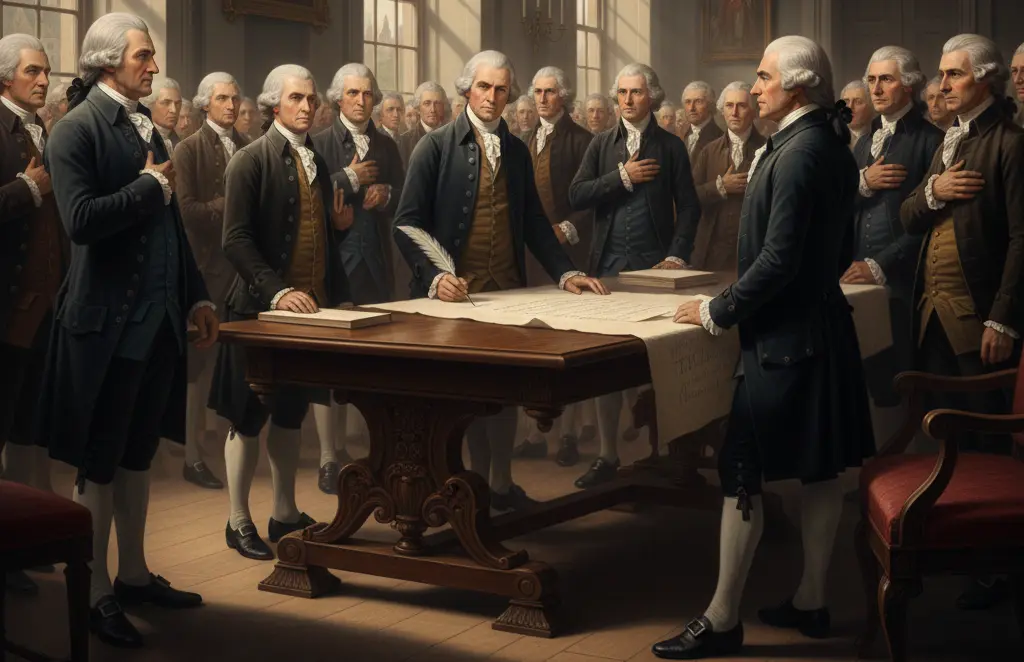
The story of how the United States became a country is full of brave acts and important words. Among all the documents and decisions that shaped our nation, one stands out as truly special: the Declaration of Independence.
It wasn’t just a piece of paper; it was a powerful statement to the world. It announced that thirteen American colonies would no longer be part of Great Britain. Instead, they would be free, independent states, ready to govern themselves.
This famous document wasn’t created overnight. It was the result of years of growing unhappiness, protests, and eventually, fighting between the colonists and the British government. It served as America’s birth certificate, declaring its existence and explaining its reasons to the world.
Part 1: The Road to Independence
For many years, most American colonists saw themselves as loyal subjects of the British King. They shared a language, culture, and traded goods with Britain. They even looked to the British military for protection, especially during the French and Indian War. However, things began to change after that war ended in 1763.
The British government found itself deep in debt because of the war. To help pay for it, Parliament (the British government) started passing new tax laws for the colonies. These included the Stamp Act of 1765 and the Townshend Acts of 1767. The colonists were furious because they had no representatives in Parliament to speak for them. They believed that only their own local governments had the right to tax them, leading to the famous cry, “No Taxation Without Representation!”
Tensions grew quickly. Events like the Boston Massacre in 1770, where British soldiers fired into a crowd of colonists, and the Boston Tea Party in 1773, where colonists dumped British tea into the harbor, made the situation much worse. The British responded with harsh laws known as the Intolerable Acts, which closed Boston Harbor and took away many of Massachusetts’s self-government rights.
These acts made it clear to many colonists that the British government was not listening to their concerns. They felt their basic rights as Englishmen were being taken away. As a result, representatives from the colonies began meeting together to discuss what to do. The idea of completely breaking away from Britain, once unthinkable, started to gain support.
Part 2: Common Sense and the Call for Freedom
Even after fighting began at Lexington and Concord in April 1775, many colonists were still unsure about leaving Great Britain entirely. They loved their British heritage and feared the unknown path of independence. It was a huge decision with unknown consequences.
However, in January 1776, a writer named Thomas Paine published a small but incredibly powerful pamphlet called Common Sense. Paine’s writing was clear and easy for everyone to understand. He argued simply and forcefully that it was time for the colonies to declare their independence. He asked how a small island (Britain) could possibly rule a whole continent (America) thousands of miles away.
Paine’s arguments quickly spread throughout the colonies, selling hundreds of thousands of copies. “Common Sense” helped many ordinary colonists realize that breaking away from Britain wasn’t just a radical idea, but a logical and necessary step. It turned the tide of public opinion and convinced many people that independence was not only possible but desirable.
The call for independence grew louder. On June 7, 1776, Richard Henry Lee, a delegate from Virginia, introduced a resolution in the Second Continental Congress (a meeting of colonial representatives in Philadelphia) stating, “That these United Colonies are, and of right ought to be, free and independent States.” This resolution was a bold step, and the Congress decided to form a committee to write an official statement explaining their reasons to the world.
Part 3: Writing the Declaration
The task of writing this incredibly important document fell to a special committee of five men: John Adams of Massachusetts, Benjamin Franklin of Pennsylvania, Roger Sherman of Connecticut, Robert Livingston of New York, and Thomas Jefferson of Virginia.
While all five contributed, the primary author of the Declaration of Independence was the young Thomas Jefferson. He was known for his elegant writing style and his deep understanding of political philosophy. The committee gave him the main responsibility for drafting the document.
Jefferson worked in his rented rooms in Philadelphia, carefully crafting the words that would define America’s new identity. He drew upon ideas from thinkers of the Enlightenment, such as John Locke, who wrote about natural rights and the idea that governments get their power from the people they govern. Jefferson believed that these truths were “self-evident”—meaning they were obvious to everyone.
He presented his draft to the committee, and they made a few small changes. Then, the revised draft was sent to the full Second Continental Congress for debate. The Congress debated the document for several days, making about 86 changes and removing roughly one-fourth of Jefferson’s original text. Some of the most significant changes included removing a section that criticized the slave trade, which was removed to gain the support of Southern colonies.
Part 4: The Core Ideas
The Declaration of Independence is divided into several main parts, each with a powerful message:
- The Introduction (The Preamble): This part explains why the colonies felt it was necessary to declare their independence. It states that when one group of people separates from another, they should explain their reasons to the world.
- A Declaration of Rights: This is the most famous part of the Declaration and contains some of the most important ideas about human rights and government. It starts with the powerful words: “We hold these truths to be self-evident, that all men are created equal, that they are endowed by their Creator with certain unalienable Rights, that among these are Life, Liberty, and the pursuit of Happiness.”
- “All men are created equal”: This doesn’t mean everyone is exactly the same, but that everyone has the same natural rights and worth.
- “Unalienable Rights”: These are rights that cannot be taken away by any government.
- “Life, Liberty, and the pursuit of Happiness”: These are the fundamental rights that governments are supposed to protect.
- Government’s Purpose: The Declaration goes on to say that governments are created to protect these rights, and if a government fails to do so, the people have the right to change or even get rid of it.
- List of Grievances (Complaints): This section is a long list of specific complaints against King George III and the British Parliament. It details all the ways the King had abused his power and violated the colonists’ rights. These complaints included:
- Taxation without consent.
- Keeping British soldiers in the colonies without permission.
- Cutting off trade.
- Denying trials by jury.
- Attacking colonial towns. These complaints showed the world that the colonists had good reasons for wanting to break away.
- The Resolution of Independence: This final part formally declares that the colonies are now “Free and Independent States.” It states that they are cut off from all loyalty to the British Crown and have the full power to make war, make peace, form alliances, and trade with other countries. It ends with a powerful promise from the signers: “And for the support of this Declaration, with a firm reliance on the protection of Divine Providence, we mutually pledge to each other our Lives, our Fortunes and our sacred Honor.”
Part 5: Signing and Lasting Impact
On July 2, 1776, the Second Continental Congress voted to approve Richard Henry Lee’s resolution for independence. Two days later, on July 4, 1776, they officially adopted the final version of the Declaration of Independence. This date is now celebrated as America’s Independence Day.
The first person to sign the Declaration, in a large, bold hand, was John Hancock, the President of the Congress. He famously said he signed it large enough for King George to read it without his spectacles. Over the next month, 56 delegates would sign the document, knowing that by doing so, they were committing treason against the British Crown and risking their lives, their fortunes, and their families.
The Declaration of Independence was more than just a break-up letter with Britain. It laid out fundamental principles that would guide the new nation. While it stated “all men are created equal,” it would take many more years of struggle, including the Civil War and the Civil Rights Movement, for that ideal to apply to all Americans, including enslaved people, women, and Native Americans.
Its ideas, especially those about natural rights and government by the people, have inspired countless movements for freedom and democracy around the world. It remains a powerful symbol of liberty and a reminder that governments should serve the people, not the other way around. It is truly America’s lasting promise to itself and to the world.
Summary Checklist
- When: Adopted on July 4, 1776.
- Who Wrote It: Primarily Thomas Jefferson.
- Why It Was Written: To explain to the world why the colonies were breaking away from Great Britain.
- Key Idea 1: “All men are created equal” and have “unalienable Rights” to “Life, Liberty, and the pursuit of Happiness.”
- Key Idea 2: Governments get their power from the people, and the people have the right to change a government that abuses its power.
- Impact: Declared America’s independence, inspired future freedom movements, and laid the foundation for American democracy.