
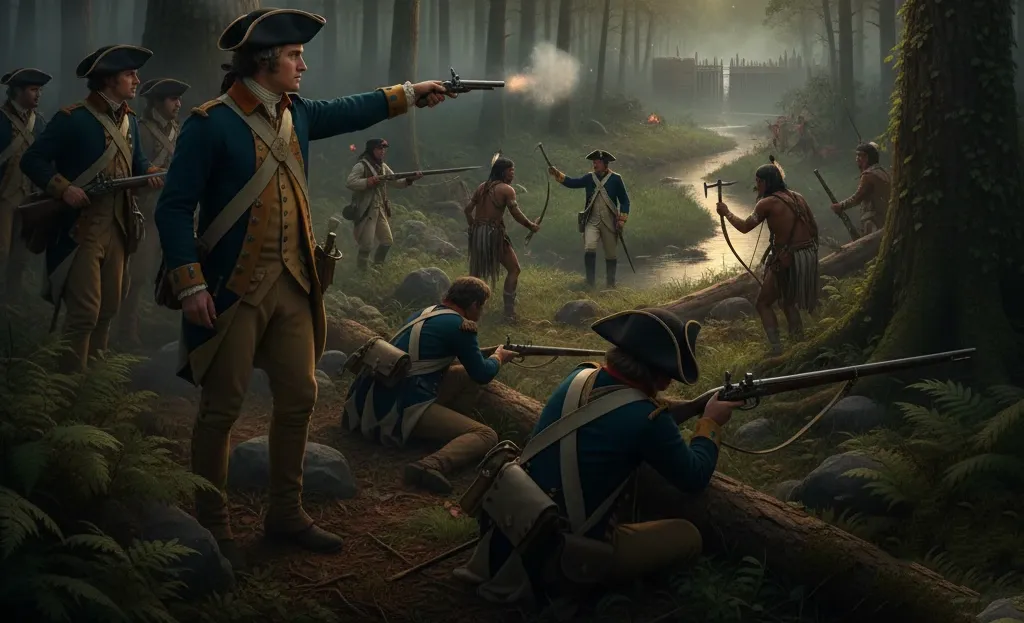
Before the United States was a country, and even before the American Revolution began, a massive conflict shook the forests and river valleys of North America. This was the French and Indian War (1754–1763).
While it might sound like a war between the French and Native Americans, they were actually mostly on the same side! The war was really a “heavyweight boxing match” between the two greatest powers of the time: Great Britain and France. Both empires wanted to control the land, the fur trade, and the future of the North American continent.
Part 1: The Seeds of Conflict
In the early 1750s, North America was divided into different “neighborhoods” owned by European powers. The British had thirteen colonies along the Atlantic Coast. The French controlled “New France,” which included parts of modern-day Canada and the Great Lakes.
The Ohio River Valley
The trouble started in a place called the Ohio River Valley (land that is now part of Pennsylvania, Ohio, and West Virginia).
- The British view: British colonists wanted to move west to find more farmland and space for their growing families.
- The French view: The French wanted to protect their fur-trading routes. They began building a chain of forts to keep the British out.
The First Spark
In 1754, a 21-year-old local militia leader from Virginia was sent to tell the French to leave. His name was George Washington. Washington’s troops got into a small battle with a French scouting party, and a French officer was killed. This small skirmish in the deep woods acted like a match hitting a pile of dry leaves. Soon, the fire of war spread across the globe.
Part 2: Choosing Sides
This war wasn’t just fought by European soldiers in bright uniforms. It involved many different groups of people, each with their own reasons for fighting.
The Role of Native Americans
Native American tribes had lived on this land for thousands of years, and they were caught in the middle.
- The French Side: Most Native American groups, like the Algonquin and Huron, sided with the French. The French were usually more respectful; they were interested in trading furs rather than building permanent farms and taking over land.
- The British Side: The powerful Iroquois Confederacy eventually sided with the British, hoping that a British victory would help protect their own territory from other tribes and the French.
The “Seven Years’ War”
While we call it the French and Indian War in America, it eventually turned into a world war called the Seven Years’ War. Fighting happened in Europe, India, and the Caribbean. It was the first truly “global” conflict.
Part 3: The Early Years of Defeat
For the first few years, things looked very bad for the British. They were used to fighting “civilized” battles in open fields in Europe. In the thick American wilderness, those tactics didn’t work.
Braddock’s Blunder
In 1755, British General Edward Braddock marched toward a French fort with a large army. He insisted on marching in straight lines and wearing bright red coats. The French and their Native American allies hid behind trees and rocks, using “guerrilla” tactics to ambush the British. Braddock was killed, and the British suffered a humiliating defeat.
The Tide Turns
In 1757, a man named William Pitt took over the British government’s war efforts. He had a new strategy:
- Spend the Money: He poured massive amounts of “credit card debt” into the war to buy better supplies and ships.
- Younger Leaders: He promoted energetic young generals who were willing to try new tactics.
- Focus on the Navy: The British Navy began blocking French ships from reaching North America, cutting off the French soldiers from food and gunpowder.
Part 4: The Path to Victory
The most famous moment of the war happened in 1759 at the Battle of Quebec. Quebec was a French city sitting high on a cliff above the St. Lawrence River. It seemed impossible to attack.
In the middle of the night, British troops under General James Wolfe secretly climbed a steep path up the cliffs. In the morning, the French were shocked to see the British army waiting for them on a flat field called the Plains of Abraham. The British won the battle, though both General Wolfe and the French commander, the Marquis de Montcalm, died from their wounds. With Quebec gone, the French empire in North America began to crumble.
The Treaty of Paris (1763)
In 1763, the war officially ended with the Treaty of Paris. The map of North America was completely redrawn:
- Britain received all of Canada and all French lands east of the Mississippi River.
- Spain (which had helped France) gave Florida to the British but received the Louisiana Territory in return.
- France lost almost all of its land in North America.
Part 5: The Unintended Consequences
The British were the “big winners,” but the victory came with hidden problems that would lead directly to the American Revolution.
| Concept | What It Meant for the Future |
| Massive Debt | The war cost a fortune. To pay for it, Britain started taxing the colonists, leading to the “No Taxation Without Representation” protests. |
| Military Experience | Colonists like George Washington learned how to fight and lead armies, skills they would later use against the British. |
| Proclamation of 1763 | To prevent more fighting with Native Americans, the King forbade colonists from moving west of the Appalachian Mountains. This made the land-hungry colonists very angry. |
| A New Identity | During the war, people from different colonies (like New York and Virginia) fought together for the first time. They began to see themselves as “Americans” rather than just British subjects. |
The Impact on Native Americans
While the British celebrated, Native American tribes realized they had lost their best leverage. Previously, they could play the French and British against each other. Now, they had to deal only with the British, who were hungry for more land. This led to Pontiac’s Rebellion, a series of bloody attacks on British forts that showed the struggle for the frontier was far from over.
Summary Checklist
- 1754: George Washington fires the first shots in the Ohio River Valley.
- 1755: General Braddock is defeated, showing that British tactics don’t work in the woods.
- 1757: William Pitt takes charge and spends heavily to win the war.
- 1759: The British capture Quebec in a dramatic cliff-side battle.
- 1763: The Treaty of Paris is signed, kicking France out of North America.
- The Aftermath: Britain is broke and starts taxing the colonies, setting the stage for 1776.
The French and Indian War was the “prequel” to the American Revolution. It removed the French threat, trained the American leaders, and created the financial problems that would eventually cause the thirteen colonies to break away and form a new nation.