
The story of how the United States began often focuses on famous battles and brave soldiers fighting in the fields. But long before the first shot was fired at Lexington, a different kind of war was happening in the minds of the colonists.
This conflict started not with a weapon, but with a piece of paper. This paper was the Stamp Act of 1765, a law passed by the British government that changed everything. It was the moment when the colonists realized that their relationship with Great Britain was broken.
This law was the “spark” that lit the fuse of the American Revolution. It turned peaceful farmers and shopkeepers into angry protesters and rebels. To understand how a simple tax led to a world-changing war, we have to look at why it was passed and why it made the colonists so furious.
Part 1: Why Did Britain Pass the Law?
To understand the Stamp Act, we have to look back at the French and Indian War. Great Britain had just finished fighting this massive conflict to protect its colonies in North America. While Britain won the war and gained a lot of new land, the victory came with a very high price tag.
The British government found itself with a mountain of “credit card debt” from paying for soldiers, ships, and supplies. They also had to keep thousands of soldiers in America to protect the new western borders. The leaders in London believed it was only fair that the colonists paid their “fair share” for this protection.
In 1765, a man named George Grenville, who was in charge of Britain’s money, came up with a plan. He convinced the British Parliament to pass the Stamp Act. This was the first time that Britain had put a “direct” tax on the colonists. Instead of taxing goods that came off of ships, this law taxed things people used every single day in their own neighborhoods.
Part 2: What Exactly Was the Stamp Act?
The Stamp Act was a law that required colonists to pay for an official government stamp on almost every piece of paper they used. If a piece of paper didn’t have the blue ink stamp on it, it was considered illegal.
People had to pay this tax on many different items, including:
- Legal Documents: Papers for buying land, getting married, or going to court.
- Daily News: Every newspaper printed in the colonies had to have a stamp.
- Business Papers: Receipts and contracts for trade.
- Fun and Games: Even playing cards and dice were taxed!
For the British, this seemed like a simple way to collect money. But for the colonists, it felt like a trap. Every time they wanted to read the news or do business, they had to give extra money to a King who lived thousands of miles across the ocean.
Part 3: “No Taxation Without Representation”
The colonists weren’t necessarily angry about the amount of money. In fact, people living in England were already paying higher taxes than the colonists. The real reason for the anger was a very important idea: Consent.
In the British system of government, people had representatives in Parliament who voted on taxes. Because the colonists lived in America, they had no one in London to speak for them or vote on their behalf. They felt that if they didn’t have a voice in the government, the government had no right to take their money.
This is where the famous phrase “No Taxation Without Representation!” comes from. The colonists believed that as British citizens, they had certain rights. One of those rights was that they could only be taxed by people they had actually elected. Since they didn’t elect anyone to the British Parliament, they argued the Stamp Act was a violation of their basic freedom.
Part 4: The Colonists Fight Back
When the news of the Stamp Act reached America, the colonies didn’t just complain—they took action. This was one of the first times that the thirteen colonies, which usually acted like separate countries, started to work together as one team.
- The Stamp Act Congress: In October 1765, representatives from nine colonies met in New York City. This meeting was called the Stamp Act Congress. They wrote a polite but firm letter to King George III, explaining that only their own colonial governments had the power to tax them. This was a huge step toward unity.
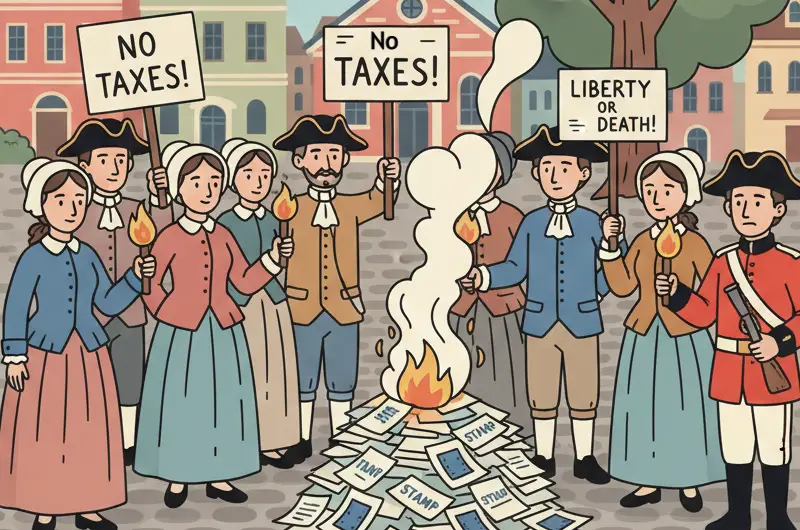
- The Sons of Liberty While the leaders were writing letters, other colonists were taking to the streets. A group called the Sons of Liberty formed in cities like Boston and New York. They were much louder and more aggressive. They organized giant protests, burned piles of stamped paper, and even threatened the people hired to collect the tax.
- The Power of the Boycott The most effective weapon the colonists used was the boycott. They simply stopped buying British goods. Merchants in the colonies refused to order clothes, tools, or tea from England. This hurt British businesses very badly. Soon, the merchants in England were the ones begging the King to get rid of the Stamp Act because they were losing so much money.
Part 5: The Repeal and the Warning
The pressure worked. By 1766, the British Parliament realized that the Stamp Act was a disaster. It was costing more money to enforce the law than they were actually making from the tax. In March of that year, Parliament voted to repeal, or cancel, the law.
The colonists celebrated in the streets with bonfires and bells. They thought they had won and that things would go back to normal. However, the British government wasn’t finished. On the same day they canceled the Stamp Act, they passed a new law called the Declaratory Act.
This new law stated that the British government had “total power” to pass any laws or taxes they wanted for the colonies “in all cases whatsoever.” It was a warning that the King was still the boss. Even though the Stamp Act was gone, the argument over who had the right to rule the colonies was just beginning.
Conclusion: A Foundation for Freedom
The Stamp Act of 1765 was a turning point in history. Before this law, most colonists were proud to be British. After the law, they started to see themselves as something different: Americans.
It taught the colonists that unity is power. They realized that if they worked together, they could change the King’s mind. They also learned that boycotts were a powerful way to fight back without using guns, and they began to think deeply about their rights and what it meant to be free.
The Stamp Act set the stage for everything that followed. It led to more taxes, more protests, and eventually, the Declaration of Independence. Without the “paper war” of 1765, the United States might never have become a nation. It remains a reminder that the fight for fair treatment and a voice in government is what built the country we know today.