
In the visually driven landscape of the 2020s, high-quality imagery is no longer a luxury—it is a requirement. Whether you are running an e-commerce store, a personal blog, or a corporate portfolio, the images you choose represent your brand’s professionalism and aesthetic. However, there is a silent conflict happening behind the scenes of every webpage: the battle between visual quality and technical performance.
High-resolution images carry a heavy digital footprint. Without proper management, these files can bloat your website, frustrate your users, and even tank your search engine rankings. This is where image compression becomes essential. By utilizing a high-quality image compresser tool, you can strike the perfect balance between stunning visuals and lightning-fast performance.
1. Speed: The Gold Standard of User Experience
The most immediate benefit of image compression is speed. We live in an era of instant gratification; statistics consistently show that if a website takes longer than three seconds to load, over 40% of users will abandon it.
Uncompressed images from modern smartphones or DSLR cameras can easily range from 5MB to 20MB. If a single blog post contains five such images, a user might have to download 50MB of data just to view one page. For users on mobile devices or slower data connections, this results in “stutter-loading,” where images pop in slowly or the page layout jumps around.
Compression reduces the file size—often by 70% to 90%—without a noticeable loss in quality. This ensures that your “hero” images and product shots snap into view instantly, keeping your audience engaged and reducing your bounce rate.
2. SEO: Pleasing the Search Engine Giants
Search Engine Optimization (SEO) isn’t just about keywords anymore; it’s about Core Web Vitals. Google has explicitly stated that page speed is a primary ranking factor for both desktop and mobile searches.
When Google’s “crawlers” analyze your site, they look at how quickly the largest contentful paint (LCP) occurs. If your uncompressed images are slowing down that process, Google will penalize your ranking, pushing you behind competitors who have optimized their media. By using an image compressor, you are essentially telling search engines that your site is technically sound and user-friendly, which helps you climb the results page.
3. Storage and Bandwidth Efficiency
For website owners, data isn’t free. Most web hosting plans have limits on storage space and monthly bandwidth.
- Storage: If every image you upload is 5MB, you will hit your server capacity very quickly. Compressed images (perhaps 200KB each) allow you to host twenty-five times more content in the same space.
- Bandwidth: Every time a visitor views your site, your server “sends” them the image data. If you have high traffic, uncompressed images can lead to bandwidth overages, resulting in extra fees from your host or even a temporary site shutdown.
4. Mobile Responsiveness
More than half of global web traffic now comes from mobile devices. Mobile users are often on the move, switching between 4G, 5G, and spotty Wi-Fi. Large image files are the enemy of mobile browsing. They drain battery life (as the processor works harder to render the data) and consume a user’s monthly data plan. Optimizing your images ensures that your site is inclusive and accessible to users regardless of their device or data constraints.
Interactive Comparison: See the Results
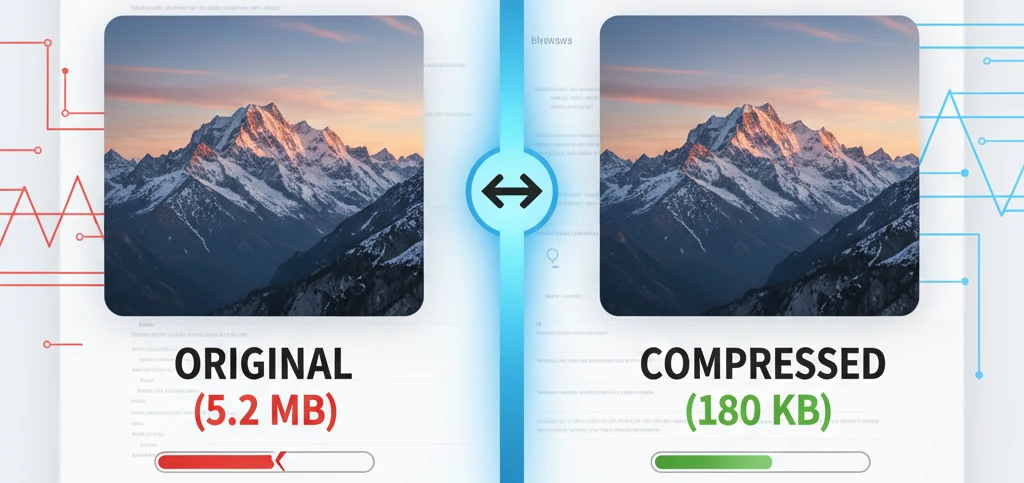
Below is a live demonstration of our compression technology. Drag the blue vertical bar to compare the Original image on the left with the Compressed version on the right. You will notice that even though the file size is drastically reduced, the quality remains professional and crisp.


78 KB were saved. The original file size was 258 KB and the compressed image file size is 180 KB.
Compress Your Images For FreeConclusion: Make Compression Your Final Step
In the world of digital publishing, the “Publish” button should never be the next step after “Save.” Between the creation of an image and its debut on the web, there must be a stop at a compression tool.
By taking ten seconds to run your files through the Everything Articles Image Compresser, you are investing in your site’s SEO, improving your user experience, and ensuring that your content is accessible to everyone, everywhere. Our tool is completely free, fast, and requires no sign-up.