
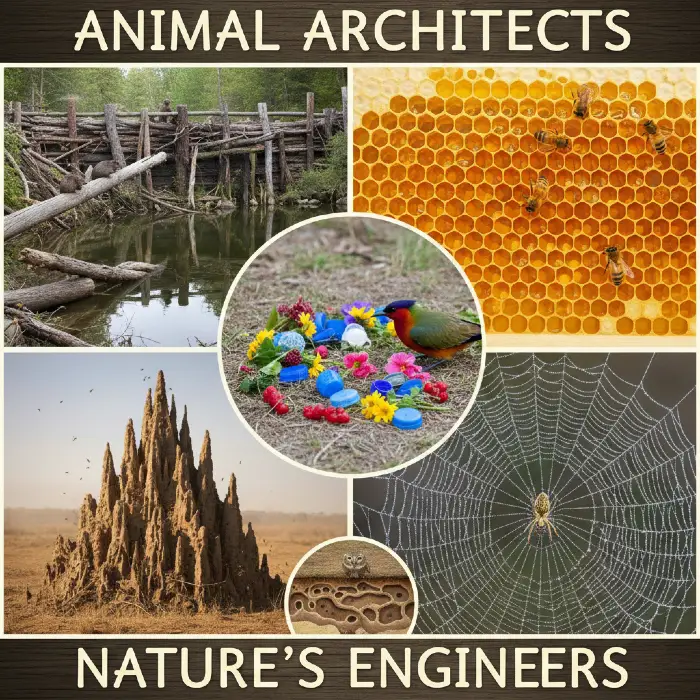
Humans often think we are the only ones who can build complex skyscrapers or massive dams. However, the animal kingdom is full of incredible architects that don’t need blueprints or power tools. From deep underwater to high in the trees, animals are constantly designing and building amazing structures.
These natural engineers use materials like mud, sticks, and even their own saliva to create homes. Their work isn’t just for show; it’s built for survival, protection, and raising families. By looking closely at their work, we can learn a lot about efficiency and clever design.
It is truly fascinating to see how a tiny insect or a furry rodent can solve big problems. They manage to stay cool in the desert and dry in the rain without any electricity. Let’s dive into the wild world of animal construction and see how they do it.
Every species has a unique style that fits its specific environment perfectly. Whether it’s for warmth or to impress a mate, these builds are incredibly impressive. Prepare to be amazed by the clever ways animals shape the world of engineering every single day.
The Busy Beaver’s Dam
Beavers are perhaps the most famous furry engineers on the planet. They spend their nights cutting down trees with nothing but their sharp, orange teeth. By blocking flowing streams with wood and mud, they create deep, still ponds that keep them safe.
These dams are remarkably strong and can even be seen from space in some cases. The beavers use heavy logs for the base and seal the cracks with stones and wet clay. This prevents water from leaking through and creates a permanent, watery habitat for many other creatures.
The Underwater Lodge
Inside the pond, the beaver builds a “lodge” which serves as its cozy family home. The entrance is hidden underwater to keep predators like wolves or bears from getting inside. It is a brilliant way to stay safe while having a dry place to sleep.
Beaver dams also help the environment by filtering water and preventing floods downstream. They act like giant sponges that hold onto water during dry seasons. It’s a perfect example of how one animal’s home can benefit an entire forest ecosystem.
Termite Mounds: Natural Skyscrapers
In the hot African savannah, tiny termites build massive mounds that look like alien towers. These structures can reach over 20 feet high, which is huge compared to a termite. They are made from a tough mixture of soil, wood, and termite spit.
Passive Cooling Systems
The most amazing part of a termite mound is the built-in air conditioning system. Even when the sun is scorching outside, the inside stays at a very steady, cool temperature. They use a complex series of chimneys to let hot air escape.
Termites are social insects that work together in perfect harmony to finish these projects. While some termites gather food, others are constantly repairing walls or digging new tunnels. This teamwork allows them to build structures that last for decades without falling apart.
Scientists actually study these mounds to learn how to make human buildings more energy-efficient. By mimicking the way termites move air, we can cool our offices using less electricity. These tiny bugs are teaching us big lessons about sustainable architectural design.
The Artistic Bowerbird
While beavers build for safety, the male bowerbird builds for romance and style. These birds live in Australia and New Guinea, where they create elaborate structures called bowers. A bower isn’t actually a nest; it’s more like a fancy bachelor pad.
The male bird spends hours arranging colorful objects like berries, flowers, and even plastic bottle caps. He usually picks one specific color, like bright blue, to decorate his walkway. The goal is to make the display as eye-catching as possible for female visitors.
If a rival bird comes by and messes up the decorations, the owner quickly fixes them. They are very picky about where every single twig and leaf is placed. This level of attention to detail is something you’d expect from a professional artist.
Female bowerbirds visit many different displays before choosing the most talented builder to be their mate. It shows that in the bird world, being a good architect is the key to a happy life. Their creativity is truly a wonder of the forest.
The Geometry of Honeycombs
Honeybees are experts at using math to save space and resources in their hives. They build their honeycombs using perfect hexagons, which are six-sided shapes that fit together perfectly. This shape is the strongest and holds the most honey using the least wax.
If bees used circles, there would be tiny gaps between the cells, wasting valuable space. If they used squares, the corners wouldn’t be as strong under the weight of the honey. The hexagon is the “Goldilocks” of shapes—it is just right for a busy colony.
The wax used to build the comb is actually produced by the bees’ own bodies. Because making wax takes a lot of energy, the bees cannot afford to be wasteful. Their precision is so high that the walls are almost exactly the same thickness.
Inside these cells, the queen lays her eggs and the workers store their sugary food. The entire hive acts like a giant, organized city where everyone has a specific place to go. It’s a masterpiece of biological engineering and efficient storage.
Spiders and the Strength of Silk
Spiders might be scary to some, but they are world-class weavers and structural engineers. They produce silk from their bodies that is five times stronger than steel of the same weight. A spider web is designed to be both flexible and incredibly tough.
When a fly hits the web, the silk stretches to absorb the impact instead of snapping. Some spiders use “dragline” silk for the frame and “capture” silk for the sticky parts. This combination makes the web a highly effective tool for catching a quick dinner.
Building a web requires a very specific sequence of movements that the spider knows by instinct. They start with a single line across a gap and then build the spokes of a wheel. It’s a complex geometric pattern that they can finish in under an hour.
Many spiders even recycle their webs by eating the old silk to regain energy. They then use that energy to spin a brand-new, clean web the very next day. This level of recycling and efficiency is something human engineers strive to achieve.
Weaver Birds: The Master Knotters
Weaver birds are famous for their ability to tie actual knots using long strips of grass. They live in Africa and Asia and build hanging nests that look like upside-down baskets. These nests dangle from thin branches to stay away from hungry climbing snakes.
A male weaver bird starts by looping a piece of grass around a twig to create a foundation. He then uses his beak and feet to weave and tuck more grass into a tight fabric. It takes hundreds of trips to gather enough material for one home.
Avian Apartment Complexes
Some species of weaver birds live in huge “apartment complexes” that house hundreds of families. These giant nests can become so heavy that they eventually break the tree branches holding them up. It’s like a bustling city made entirely out of dried yellow grass.
The nests are designed with long entrance tubes that point toward the ground. This makes it very difficult for predators to crawl inside while the birds are sleeping. It’s a clever defensive design that has worked for thousands of years.
Underground Cities of Prairie Dogs
Prairie dogs are social rodents that build massive underground towns called “towns” or “colonies.” These tunnels can stretch for miles across the Great Plains of North America. They include specialized rooms for sleeping, nurseries for babies, and even bathrooms.
Natural Ventilation
To keep the air fresh deep underground, prairie dogs build mounds of different heights at the entrances. This creates a pressure difference that forces a breeze through the tunnels, providing natural ventilation. They essentially built their own fans using nothing but dirt.
Living underground provides excellent protection from extreme weather like thunderstorms or blazing summer heat. It also keeps them hidden from hawks and coyotes that hunt from the sky or the surface. Safety is the main priority for these clever little excavators.
Prairie dogs are also very vocal and have a complex “language” to warn others about danger. When one dog barks, the news travels fast through the tunnels so everyone can hide. Their architecture and social lives are perfectly linked for their survival.
Coral Reefs: The Largest Living Structures
Coral reefs are actually built by tiny animals called polyps that live in the ocean. These polyps create hard skeletons out of calcium carbonate, which pile up over thousands of years. The result is a massive underwater structure that can be seen from space.
The Great Barrier Reef is the most famous example and is home to thousands of different species. These reefs act like underwater cities, providing food and shelter for fish, sharks, and turtles. They are essential for the health of our planet’s vast oceans.
Reefs also protect our coastlines by breaking the power of big waves during heavy storms. Without them, many islands and beaches would simply wash away into the sea over time. They are natural barriers that save lives and protect property every year.
Even though they look like rocks, corals are living creatures that need clean water to survive. They remind us that the smallest builders can create the biggest impacts on the world. Protecting these underwater architects is vital for the future of our beautiful blue planet.
Lessons from the Wild
It is clear that humans aren’t the only ones with a talent for construction and design. From the beaver’s heavy dam to the spider’s delicate web, nature is full of incredible engineering. These animals show us that with hard work and the right materials, anything is possible.
By studying how animals build, we can find better ways to live in harmony with nature. We can learn to build cooler houses, stronger bridges, and more efficient cities for ourselves. Nature has already solved many of the problems we are still trying to figure out today.
The next time you see a bird’s nest or a simple spider web, take a moment to look closer. You are looking at a masterpiece of engineering that didn’t require a single computer or crane. The world is a giant workshop, and animals are the master craftsmen.