
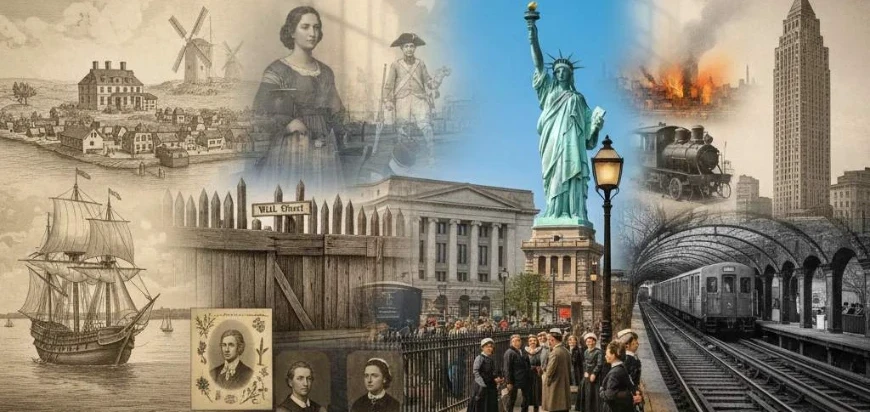
In 1609, the Dutch claimed the New York area as part of New Netherland. The colony was a vital hub in the transatlantic fur trade and eventually transformed into a significant agricultural resource through the patroon system. A patroon was a wealthy landholder granted manorial rights to vast tracts of land. These manorial rights empowered the owner of an estate to govern the territory, manage hunting and fishing, and host essential community fairs and markets.
This system created a feudal-like structure in the Hudson Valley, where families like the Van Rensselaers held immense power. However, the Dutch influence faced a sudden shift in 1664 when the English sent a fleet to conquer New Netherland. Lacking sufficient defenses, the inhabitants surrendered without a fight, and the city was renamed New York.
Labor, Slavery, and Early Rebellion (1711–1712)
By 1711, New York had established a formal slave market on the eastern end of Wall Street. Operating for decades, it was central to human trafficking in the growing city. Enslaved Africans and Native Americans were subjected to various forms of labor, including domestic work, construction, and shipping.
Because the region lacked the sprawling plantations found in the South, many enslaved individuals were trained in specialized urban trades such as carpentry and masonry. Despite their contributions, the brutality of the system led to the New York Slave Revolt of 1712. An estimated 20 to 70 participants set fire to a building and attacked settlers who responded. While the rebellion caused significant chaos, it was quickly suppressed by the militia, leading to harsh legal reprisals and executions that tightened the city’s slave codes.
Urban Evolution: Parks, Plays, and Public Safety (1732–1762)
Cultural life began to bloom on December 6, 1732, when New York hosted its first professional play, The Recruiting Officer. Written by George Farquhar in 1706, the play reflected the city’s growing appetite for European entertainment. Shortly after, on March 12, 1733, the Common Council established Bowling Green as the city’s first official park. Originally a multi-functional space for cattle markets and Dutch-style bowling, its enclosure with a sturdy iron gate—which still stands today—marked a shift toward intentional urban planning.
Public safety also modernized during this era. In 1737, the city established its first volunteer fire department. Though they used primitive leather buckets and rattles for alarms, these volunteers laid the groundwork for the modern FDNY. By 1762, the city installed its first tax-paid streetlights. These simple wooden posts topped with lanterns were eventually replaced by cleaner gas and electric lighting as technology advanced.
The Revolution and the Great Fire (1776–1783)
The American Revolution brought deep divisions. Mayor David Mathews remained a staunch Loyalist and was arrested in June 1776 for his alleged involvement in the Hickey Plot, a conspiracy to assassinate George Washington. On July 9, 1776, after the Declaration of Independence was read to troops in New York, a statue of King George III was toppled.
The British soon captured the city, leading to a long military occupation. Disaster struck on September 21, 1776, when the Great Fire engulfed the city, destroying roughly one-fourth of its buildings. Amidst the chaos, the British executed Nathan Hale, a colonial spy whose last words—“I only regret that I have but one life to lose for my country”—became a rallying cry for the patriot cause. British occupation finally ended on Evacuation Day, November 25, 1783, signaling the birth of American self-governance.
Economic Pioneers and the Empress of China (1784–1791)
Following the war, Alexander Hamilton founded the Bank of New York in 1784. It became one of the first institutions to issue a loan to the fledgling U.S. government. Simultaneously, New York looked toward global trade. On February 22, 1784, the Empress of China set sail for Canton (Guangzhou).
The ship carried American ginseng—highly valued in China for its medicinal properties—and returned a year later laden with silk, tea, and porcelain. This successful voyage opened the “Old China Trade,” cementing New York’s status as a premier international port.
Scientific and Industrial Giants: Colden and Cooper
New York was also a cradle for scientific achievement. Jane Colden, born in 1724, is recognized as the first major female American botanist. She classified over 400 species of flora in the Hudson River Valley using the Linnaean system.
In the 19th century, Peter Cooper became a titan of industry. Born in 1791, he invented the Tom Thumb, the first American steam locomotive.
Cooper’s legacy extended beyond machines; he founded the Cooper Union in 1859, offering free education to the working class. Curiously, he also developed the first patent for a gelatin dessert, which would later become Jell-O.
Social Progress and the Abolition of Slavery (1799–1806)
In 1799, the state legislature passed the Act for the Gradual Abolition of Slavery. This law dictated that children born to enslaved mothers after July 4, 1799, would eventually be free, though they remained bound to service until their late twenties. While a slow process, it was a critical step toward the total emancipation of 1827.
During this time, social welfare also became a priority for private citizens. In 1806, Eliza Hamilton (widow of Alexander Hamilton) co-founded the New York Orphan Asylum Society. This organization, now known as Graham Windham, continues to serve thousands of children and families today, making it one of the oldest social service agencies in the country.
The War of 1812 and the Rise of Wall Street
The War of 1812 disrupted Atlantic trade but paradoxically stimulated New York’s domestic manufacturing and shipbuilding. Following the war, the city’s financial sector matured. In 1817, the New York Stock and Exchange Board was formally organized. Originally a small group of brokers meeting under a buttonwood tree, it evolved into the New York Stock Exchange (NYSE), which today manages trillions of dollars in market capitalization.
Engineering Marvels and Disasters (1825–1835)
The completion of the Erie Canal in 1825 was a turning point for New York’s economy. Dubbed “Clinton’s Ditch” after Governor DeWitt Clinton, it connected the Great Lakes to the Atlantic Ocean, making New York City the gateway to the American West.
However, growth was often met with tragedy. In December 1835, another Great Fire broke out in Lower Manhattan. Driven by freezing winds that hampered firefighting efforts, the blaze destroyed 700 buildings and caused $20 million in damages. The disaster led to the creation of the Croton Aqueduct system to ensure the city never ran out of water again.
Panic, Famine, and the Birth of the GOP (1837–1854)
Economic instability struck during the Panic of 1837, a financial crisis caused by speculative lending and falling cotton prices. As banks shuttered, the city’s poor were hit hardest. Conditions worsened in the 1840s as the Irish Potato Famine drove hundreds of thousands of immigrants to New York’s shores.
In 1854, the Republican Party was formed in response to the Kansas-Nebraska Act. This “Grand Old Party” (GOP) found significant support among New York’s merchants and abolitionists who opposed the expansion of slavery and favored industrial growth through high tariffs and a national banking system.
The Civil War and the Professionalization of Safety
When the Civil War broke out in 1861, New York became the Union’s primary source of manpower and supplies, sending 465,000 troops to the front. The war changed how the public perceived conflict; the advent of the camera allowed New Yorkers to see the gruesome reality of the battlefield for the first time.
After the war, in 1865, the city transitioned from volunteer fire brigades to the Metropolitan Fire Brigade. This professionalization ensured that firefighters were trained and paid, leading to the highly disciplined FDNY we recognize today. That same year, the city fell into mourning as Abraham Lincoln’s funeral procession passed through, with 100,000 people paying their respects to the fallen president.
The Gilded Age: Museums, Medicine, and Modernity (1873–1893)
The late 19th century saw a boom in institutional growth. In 1873, the Bellevue Hospital School of Nursing was founded, applying Florence Nightingale’s principles to modernize medical care. In 1877, the American Museum of Natural History opened its doors, housing a collection of meteorites and gemstones that would eventually be worth hundreds of millions of dollars.
Technological and commercial oddities also emerged. In 1857, Joseph Gayetty marketed the first commercial toilet paper in New York—though it was famously “splintery” until improvements were made decades later. In the 1880s, New York also witnessed the gift of the Statue of Liberty from France, a monumental feat of engineering designed to welcome immigrants to the “Golden Door.”
The 20th Century: Subways and Pandemics (1893–1918)
As the city grew upward with skyscrapers like the Singer Building (briefly the tallest in the world in 1908), it also grew downward. The New York City Subway opened on October 27, 1904, revolutionizing urban transit with its “Automatic Block Signal” system.
However, the city’s density made it vulnerable. In 1918, the Spanish Flu arrived via European vessels. Over three waves, the pandemic claimed 30,000 lives in New York City alone. This tragedy, occurring at the end of World War I, forced the city to overhaul its public health protocols once again.
From its humble Dutch beginnings to its role as a global leader in finance, culture, and industry, New York City’s history is a testament to resilience and constant reinvention.