
The story of the American Revolution is one of the most exciting and important chapters in world history. It wasn’t just a war with soldiers and muskets; it was a battle of ideas. It was the moment when thirteen small colonies decided they would rather risk everything for freedom than live under the rule of a King thousands of miles away.
This journey from being British subjects to becoming American citizens changed the world forever. To understand how it happened, we have to go back to a time when the “United States” didn’t exist, and the land was a collection of woods, farms, and growing cities along the Atlantic coast.
Part 1: Why Were the Colonists Angry?
For a long time, the American colonists were actually quite happy being part of the British Empire. They shared a language, traded goods like tobacco and cotton, and looked to the British King for protection. But in the mid-1700s, things began to change.
The Cost of War
From 1754 to 1763, Great Britain fought a massive conflict called the French and Indian War. While Britain won and gained a lot of land in North America, the war was incredibly expensive. To pay off their debt, the British Parliament decided to tax the colonies.
“No Taxation Without Representation”
The British started passing laws like the Stamp Act (1765), which taxed paper goods like newspapers and playing cards, and the Tea Act (1773). The colonists weren’t necessarily angry about the money itself—they were angry about how it was done.
In Britain, people had representatives in Parliament who voted on taxes. But the colonists had no one to speak for them. They famously declared, “No Taxation Without Representation!” They felt that if they didn’t have a voice in their government, the government had no right to take their money.
Tensions Boil Over
As the British sent more soldiers to the colonies to keep order, tempers flared.
- The Boston Massacre (1770): A snowy night in Boston turned deadly when a crowd of colonists taunted British soldiers. Shots were fired, and five colonists died. This event made many people realize that the British were no longer acting like protectors, but like occupiers.
- The Boston Tea Party (1773): To protest the tax on tea, a group called the Sons of Liberty dressed up and dumped 342 chests of British tea into Boston Harbor. It was a massive act of “civil disobedience” that pushed the King to his limit.
Part 2: The Path to Independence
By 1774, the colonies were starting to work together. They formed the First Continental Congress, where leaders from different colonies met in Philadelphia to discuss how to handle the British.
The Shot Heard ’Round the World
War officially began on April 19, 1775. British troops marched toward the towns of Lexington and Concord to seize hidden weapons and arrest rebel leaders. Paul Revere made his famous midnight ride to warn the local militia (called “Minutemen” because they could be ready in a minute). No one knows who fired first, but that morning, the Revolutionary War began.
The Declaration of Independence
Even after the first battles, many colonists were still nervous about breaking away from Britain completely. But a writer named Thomas Paine published a pamphlet called Common Sense, which used simple language to explain why a small island (Britain) shouldn’t rule a whole continent (America).
On July 4, 1776, the Second Continental Congress adopted the Declaration of Independence. Written mostly by Thomas Jefferson, this document told the world that “all men are created equal” and have the right to “Life, Liberty, and the pursuit of Happiness.” It was a “break-up letter” to the King, and there was no turning back.
Part 3: The Long, Hard Fight
The war lasted eight long years. On paper, the Americans should have lost quickly. The British had the best navy in the world and highly trained soldiers. The Americans had a “Continental Army” made up of farmers and shopkeepers who often didn’t even have shoes or enough gunpowder.
George Washington’s Leadership
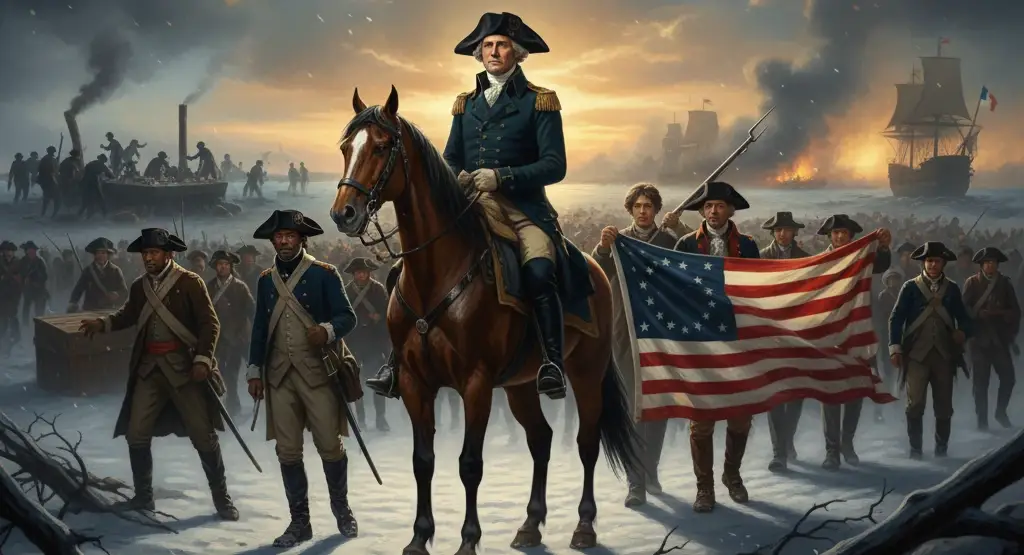
The Americans had one secret weapon: General George Washington. He wasn’t the greatest battlefield strategist, but he was an incredible leader. He kept his army together through freezing winters, like the one at Valley Forge, where many died of cold and hunger. His goal wasn’t just to win every battle, but to keep the army alive until the British got tired of fighting.
The Turning Point at Saratoga
In 1777, the Americans won a massive victory at the Battle of Saratoga in New York. This was a game-changer because it proved to the rest of the world that the Americans actually had a chance. Because of this win, France decided to join the war on the American side, sending ships, money, and soldiers.
The Southern Campaign and Guerilla Warfare
As the war moved into the Southern colonies, the fighting became very messy. Local “Patriots” (who wanted independence) fought “Loyalists” (who wanted to stay British) in their own neighborhoods. American leaders like Nathanael Greene used “hit-and-run” tactics to tire out the British army, leading them on long chases through the woods and swamps.
Part 4: Victory and Peace
The final major act of the war took place at Yorktown, Virginia in 1781.
British General Cornwallis moved his army to a peninsula, thinking the British Navy would protect him. However, the French Navy arrived first and blocked the sea, while Washington’s army and French troops surrounded him on land. Trapped, Cornwallis was forced to surrender.
The Treaty of Paris
It took two more years of negotiating, but in 1783, the Treaty of Paris was signed. Great Britain officially recognized that the thirteen colonies were now free and independent states.
Part 5: The Legacy of the Revolution
The American Revolution didn’t just create a new country; it created a new way of living.
| Concept | What It Meant |
| A Republic | Instead of a King who ruled because he was born into it, the people would choose their own leaders. |
| The Constitution | A “rulebook” for the government was written to make sure no one person ever got too much power. |
| Individual Rights | The Bill of Rights was added to protect freedoms like speech, religion, and the press. |
A Changing World
The Revolution had a ripple effect across the globe. Soon after, the people of France rose up against their King, and movements for independence began to spread across Latin America.
However, the Revolution was also an “unfinished” story. While the Declaration said “all men are created equal,” slavery continued in the South for nearly another century, and women and Native Americans were not given the same rights as white male landowners. The Revolution gave Americans the tools and the ideals to work toward a fairer society, a journey that continues to this day.
Summary Checklist
- 1760s-1770s: Taxes like the Stamp Act make colonists angry.
- 1775: Fighting starts at Lexington and Concord.
- 1776: The Declaration of Independence is signed.
- 1777: Victory at Saratoga brings help from France.
- 1781: The British surrender at Yorktown.
- 1783: The United States is officially recognized as a new nation.
The American Revolution was a bold experiment. It proved that ordinary people could stand up to an empire and build a government “of the people, by the people, and for the people.” It remains a reminder that freedom is something that must be earned, protected, and cherished.