
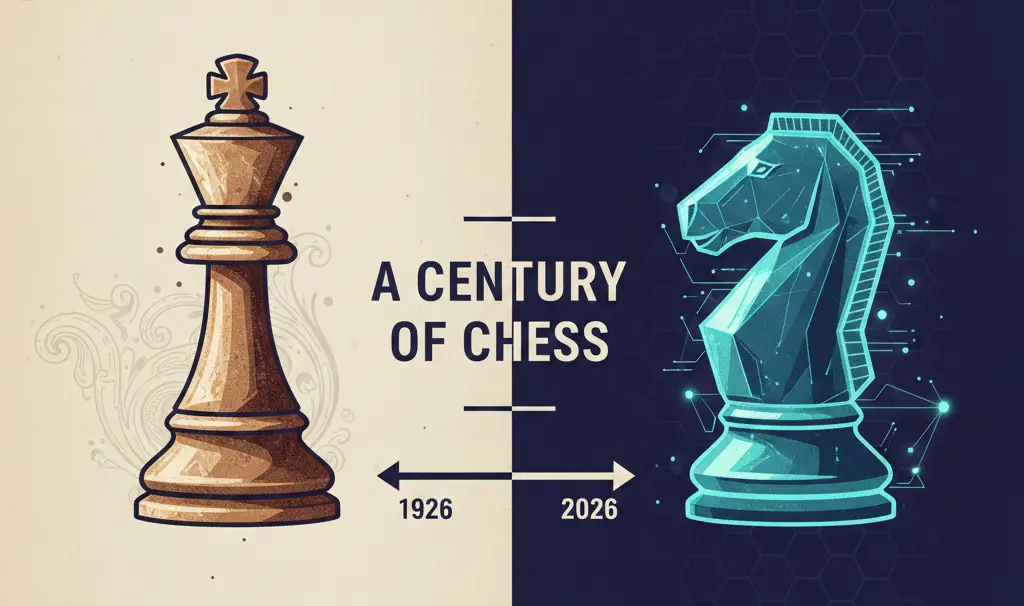
Writing about the history of chess can sometimes feel like reading a dusty textbook, but when you look at how the game has changed from 1926 to 2026, it’s actually a wild story about humans, machines, and the search for “truth” on 64 squares.
Imagine a time machine. If we took a Grandmaster from 1926 and dropped them into a tournament today, they would recognize the pieces, but they might not recognize the game. Here is how a century of strategy has transformed the way we play.
The 1920s: The Era of “Scientific Romanticism”
In 1926, the chess world was obsessed with two things: Aron Nimzowitsch (author of the foundational text My System) and his “Hypermodern” ideas.
Before this time, most people believed you had to occupy the center of the board with pawns immediately (think 1. e4 or 1. d4). But in the 1920s, the “Hypermoderns” said, “Wait a minute. What if we let the opponent take the center, and then we attack it from the sides like a sniper?”
The Strategy: “The Sniper Approach”
In 1926, the Fianchetto (putting your Bishop on the long diagonal at g2 or b2) was the height of fashion. Players like Nimzowitsch and Richard Réti were proving that a Bishop hiding in the corner could be just as deadly as a pawn in the middle. This era saw the rise of the [Réti Opening] and the [Queen’s Indian Defense], which used indirect pressure to dismantle traditional centers.
- Key Idea: Control, don’t just occupy.
- Strategic Philosophy: Elegant and Experimental
- The Hero: Alexander Alekhine, who was just a year away from becoming World Champion. He played with a fiery, tactical energy that was balanced by these new “scientific” positional rules.
The 2026s: The Era of “Neural Precision”
Fast forward 100 years. It’s 2026, and the best player in the world isn’t a human—it’s an AI called Stockfish 17 (or its cousins, Leela Chess Zero and AlphaZero).
Today’s top humans, like Gukesh or Magnus Carlsen, don’t just “guess” what the best move is. They study with Neural Network Engines that can see 40 moves ahead in a fraction of a second. This has changed chess from a game of “general rules” into a game of “concrete exceptions.”
The Strategy: “Whatever Works”
In 1926, a master might say, “Don’t move your Queen too early.” In 2026, the computer says, “Move your Queen to the corner of the board on move 5, but only if you follow it up with this specific pawn push on move 12.” Modern theory is concrete; top-tier preparation often involves 20-move memorization dictated by engine lines.. We no longer care if a move looks “ugly” or “unprincipled.” If the computer says the evaluation is +0.4, we play it.
- Key Idea: Calculation over intuition.
- The Modern Paradigm: High-Speed Precision and Centaur Play (human-AI collaboration in training).
- The Hero: Gukesh Dommaraju, the young World Champion who represents the “Engine Generation”—players who grew up with AI as their primary coach.
The Big Differences: Side-by-Side
| Feature | 1926 Strategy (Classical) | 2026 Strategy (Modern/AI) |
| Center Control | Occupancy & Hypermodernism | Dynamic & Fluid Control |
| King Safety | Fixed Pawn Shield | Active/Fighting King |
| Preparation | Manual Game Review | AI-Cloud Analysis |
| Endgame Focus | Adjudication/Draw Culture | Maximum Resistance/Fighting |
| Engine Eval | Intuitive Assessment | Concrete Calculation (+0.4 accuracy) |
The “Human” Side of the Game
The most interesting thing about 2026 isn’t that we are better at chess than people in 1926—it’s that we are different kinds of humans.
In 1926, chess was a social club. You sat in a smoke-filled room in Dresden or New York, wore a suit, and played one game a day. If you wanted to learn a new opening, you had to wait months for a magazine to arrive in the mail.
In 2026, chess is a global esport. A kid in a bedroom can play 50 games of “Bullet” chess against people from 10 different countries before breakfast. We have “Chess960” (also known as Freestyle Chess), where the starting positions of the pieces are randomized. This variant was created specifically to combat “engine draws” and move away from the heavy memorization of opening books, forcing players to rely on pure creativity from move one.
Why accuracy still matters
Even though we have computers, the “human” blunders haven’t gone away. We still get nervous. We still “tilt” after losing. We still forget that a Bishop can strike from all the way across the board.
The 1926 masters were trying to find “The Truth.” The 2026 masters know “The Truth” is often too complicated for a human brain to hold, so they focus on making the game as difficult as possible for their opponent.
Final Thought: What hasn’t changed?
If Alexander Alekhine (1926) sat down across from Gukesh (2026), they would both feel the same “thump-thump” of their hearts when they launch a sacrifice.
The tools changed. The knowledge grew. But the feeling of finding a beautiful move? That has stayed exactly the same for 100 years.